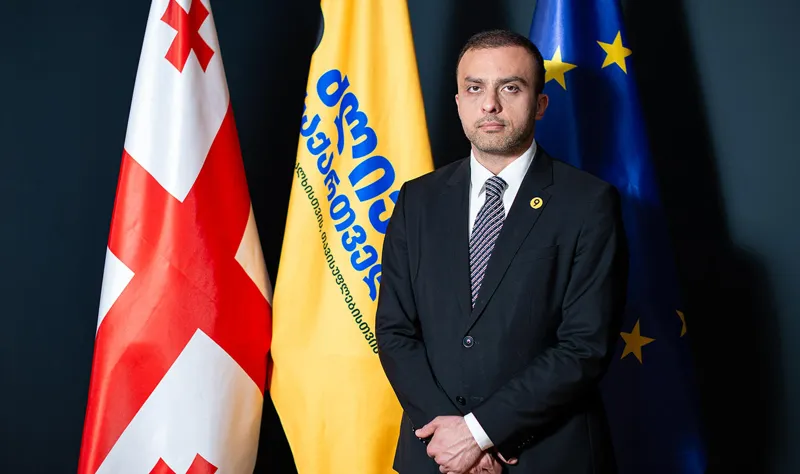
Europe has received firm guarantee from the Georgian PM and Head of the leading party that Georgia will not be pushed from the chosen path to the EU– Lavan Bodzashvili
- The visit by the Premier and the Governmental delegation to Europe can really be defined as rather impressive as within it Brussels as well as other European countries have been provided with all key messages regarding Georgia’s European choice. Within the visit, some paramount decisions have also been made. How would you evaluate the political repercussions of this visit? Has Europe been convinced that Georgia’s political vector has remained unchanged?
- The aforementioned visit was paramount because of two core reasons: 1. it was conditioned with the first session of the Association Council and 2. it has brought all discussions regarding the authorities’ alleged desire to change our foreign course to an end. Each and every statement from different official figures, including the EU commissioners or the NATO Secretary General directly point to the fact that our Government is resolute in its decision to follow the already chosen path to the EU. I don’t really think that the ouster or resignation of some high officials could have been viewed as a desire to change the foreign political vector especially in the present state of play when the core directions of our foreign policy are determined by the Parliament and not by this or that minister. Therefore, even if a political will to do this had emerged, they would have failed to change Georgia’s political course because of resignation of some Georgian top officials. Consequently, our partners could really not have been left with an impression that Georgia has veered from the chosen path; however, our authorities ought to have emphasized this at the international scene.– In the words of Premier, Irakli Gharibashvili, Georgia and the EU have advanced to a new phase in their relations. As far as we are concerned, a slew of decisions have been made within the governmental delegation’s visit to Brussels. Could you specify of what kind of practical importance the decisions in Brussels will have? At what the first Association Council Session between Georgia and the EU may aim? Or what kind of a connotation can Federica Mogherini’s have statement saying that Georgia and the EU will get involved in even closer partnership? In addition, we would like to know on what they intend to spend 30 million Euros allocated by the EU to Georgia?
- New Status Quo in the Georgia-EU relations surfaced as early as on September 1, when 80 percent of the European Union Free Trade Agreement temporarily came into effect.
Within this paramount visit, an agreement on implementing the second phase of the visa-liberalization action plan was also reached. However, some naysayer countries in the European Union are skeptically disposed to establishing a visa-free travel with the alien states. Although our government has succeeded in overcoming this skepticism and this is obviously immensely auspicious for us. The Association Council is a supreme coordinating body aiming to implement the association agreement. Apart from the council, other working committees, including parliamentary committees, also serve this common purpose. Other tools that aim at effectively implementing the Association Agreement and that are created by the Georgian side as well as the EU are also involved in this process.
In 2014-2017, the EU is expected to donate around 410 million Euros to Georgia. This financial assistance must be partially channeled into the projects aiming to boost the Georgian production and manufacturing standards as after a full implementation of the Association Agreement, the Georgian farmers and enterprisers will have to withstand some stiff competition in which they obviously will be involved after the landmark deal comes into effect.
- The EU has congratulated Georgia on successfully completing the first phase of the Association agreement. In the words of our Justice Minister, Tea Tsulukiani, within its second phase, the EU will follow carefully the ongoing developments in Georgia and will monitor the process of enacting the already elaborated reforms. From a practical point of view, what does the completion of the first phase of the agreement mean or what does the second phase envisage? And what kind of prospects of establishing visa-free travel with the EU are there at this point in time?
- The second phase conditions an effective implementation of the readmission agreement without which the EU is unlikely to grant us visa-free travel with it. All state institutions, including judicial bodies, really have a great deal left to do in this direction. We have to meet the EU criteria as well as its requirements. The Foreign Ministry is in charge of this and as far as I am concerned, all state agencies, including the Prime Minister’s office, are actively involved in this process. The EU is also carefully following the ongoing developments in Georgia and after paying visits to Georgia and after conducting routine surveys here, the western leaders are expected to gauge how successfully we have accomplished this process. Thus, today, our future is in the government’s hands – if they address all requirements from the EU, everything will obviously run smoothly and we will manage to establish visa-free travel with the EU.
We should also bear in mind that visa-liberalization does not guarantee us free travel opportunities. This is not envisaged by the Association Agreement. Consequently, only those citizens of Georgia who will visit different European countries for not more than 90 days will enjoy the visa free travel opportunities. And this, in its turn, has its own requirements – beginning with biometric IDs and ended with the implementation of general readmission regulations. If everything runs smoothly, Georgia will manage to establish visa-free travel with the EU by 2016 or even earlier.
--How would you evaluate the meetings at the NATO Headquarters as well the statement from newly appointed NATO Gen Secretary, Jens Stoltenberg, in whose words, they’ve decided to found a NATO Military Base in Georgia. As far as you remember, they passed harsh criticism on the former Defense Minister for making the aforementioned political prediction…
- By involving the new Defense Minister in the delegation, they have made a truly correct decision. The replacement of ministers must not in any way influence the dynamics of NATO-Georgia relations. By taking this step, they’ve delivered a message to NATO saying that our foreign course has remained unchanged. As for the opening of NATO Military Training Center in Georgia, this decision has already been made in NATO and Stoltenberg simply stated that this decision will come to fruition soon.- According to James Appathurai, by completing agreements with Georgia’s breakaway regions, Russia will even more isolate itself from the international space. How big of a chance Russia stands to do this?
-- This will be so but we will not benefit from Russia’s isolation. Isolating Russia is much more problematic for Europe than holding a dialogue with it. However, Europe is still trying to thaw relations with Russia. To corroborate this statement, we can bring a statement from the German Foreign Minister who, after 6-hour long consultations between the Russian President and the German Chancellor, declared that holding joint consultations of the Eurasian Union and EU is desirable. Although, Europe is also determined to realize its plans in terms of Eastern partnership countries. Europe seeks ways to launch a dialogue with Russia in order to deter it. Accordingly, a decision to isolate this country can be made only as a last resort.
-- Moscow has urged Kiev to put a guarantee that it will never join NATO on the table. Allegedly, this issue concerns the Kremlin; however, they don’t specify what kind of steps they intend to take to resolve it. If the Kremlin wants Ukraine not to integrate itself with NATO, what will prevent the Russian leaders from requiring the same from Georgia too? How can we credit that Russia will adopt an inert posture and will refuse to react to their move to open the NATO Military Training Center here?
- Putin is very well aware of the fact that such guarantees simply do not exist, and he is now trying to get them by depredating in other countries and provoking tensions as well as pisiveness there. We must comprehend that the conflicts sparked by Russia in different regions bars the prospects for the enlargement of NATO.
- Can we surmise that in return for refusing to negotiate a bargain with Georgia’s breakaway regions, Russia will urge the Georgian authorities to decline a proposal of opening the NATO Military Training base here?
- If we get involved in a dialogue with Russia regarding this issue, we will face a totally new reality and the Government will have to make a choice between the given two options. However, years-long experience has also clearly demonstrated that no other country but Russia has systematically pushed Georgia to NATO. This country has always subjected us to its overwhelming aggression. Consequently, chances for holding similar dialogues between the two countries are extremely small.
- They have drafted four versions of the agreement on the so-called two-key system in wiretapping. It’s an actual fact that this issue has stimulated discrepancy and opinion clashes in our public. Since our Government seeks to implement European standards in the country, could you tell us how they can resolve this issue without violating the European standards?
- The European Court clearly stipulated its standards in its decision of 8 April. The decision says that absolutely nobody on earth is entitled to permanently monitor the people’s private lives since there is not even a theoretical guarantee that they will not breach the people’s inviolable rights by doing this. Thus, a two-key system in wiretapping is something absolutely inadmissible as only the court is entitled to allow monitoring whenever the necessity for doing this emerges. Only in this way will they manage to toe the line and distance themselves from violating our people’s fundamental rights. Consequently, the two key-system either must not exist or our court must be in charge of it. According to the Association Agreement, the European standards must also be observed while dealing with the people’s personal data. Accordingly if the Government does not desire to undercut the prospects of establishing visa-free travel with the EU, it will have to implement these standards in the so-called two-key system as well.
Koba Bendeliani
InterPressNews