Nika Gvaramia to Revaz Nadaraia: "You cannot conduct the proceedings in such a one-sided manner! I will file a motion for your recusal. How are you speaking to me? When did you decide that you have the right to speak in this tone?"
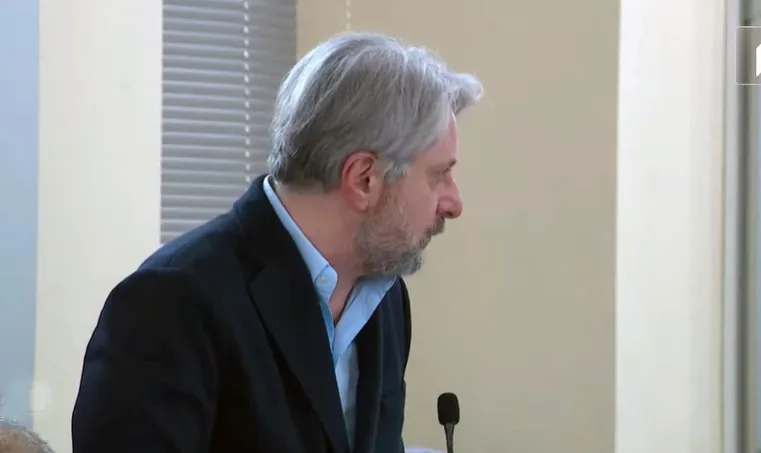
"You cannot conduct the proceedings in such a one-sided manner! Please, let me speak! I am going to file a motion for your recusal. How are you speaking to me? When did you decide that you have the right to speak in this tone? I am substantiating my motion in the way I deem necessary—please, do not interrupt me." This is how Nika Gvaramia, one of the leaders of the "Coalition for Change," addressed Revaz Nadaraia, the presiding judge of the Constitutional Court. The exchange took place during the review of a lawsuit filed by "Georgian Dream" MPs seeking the banning of five opposition parties—a session in which Levan Samushia, a representative of "Lelo – Strong Georgia," had submitted a motion to examine evidence.
A verbal altercation occurred between Nika Gvaramia and the presiding judge of the Constitutional Court as Gvaramia was presenting his position.
"I do not know what the court is basing its position on when it claims that these [links] constitute evidence—and that such evidence need not be presented in a tangible, physical form. I do not know the basis for this assertion. We have handled numerous cases in the common courts where such material is not considered evidence. Furthermore, there is no guarantee that these 'links' will even open correctly. This does not constitute evidence; the required formal criteria have not been met. I have never—in any legal proceeding—heard a suggestion that we should forgo examining the content. To put it plainly: you have acted in an inquisitorial manner, in violation of the law; your classification of this material as evidence is a flagrant breach of the law. I can point to your own previous rulings—instances where a witness’s identity was not established, yet you took it upon yourselves to establish it. Through your own court order, you have violated the law. You have your procedural rights, and I have mine—rights of which I am fully aware. Others may perhaps be unaware of their own procedural rights, but I am not; therefore, please allow me to speak[...] Given this, I will now file a motion for your recusal. How dare you speak to me in this manner? When did you decide that you have the right to address me like this? I am substantiating my motion in the way I deem necessary; please, do not interrupt me—I urge you, let me speak... I am substantiating a motion, so please allow me to do so; the proceedings cannot be conducted in such a one-sided manner! The principle of an adversarial process has not been abolished, even alongside inquisitorial elements. If anyone thinks otherwise, they are mistaken—either regarding the law, legal theory, or both. If you do not allow me to examine this evidence, how am I supposed to convince you? The stage of examining evidence—which includes the submission of material evidence and its examination here—is a step the court cannot, and should not, skip. Therefore, we support this motion," stated Nika Gvaramia.
In response to the opposition politician, the Chairman of the Constitutional Court, Revaz Nadaraia, pointed out that he should confine his remarks to the motion itself, adding that he does not have the "right to do whatever he pleases" in court.
"You also seem to think that you have the right to do whatever you please, but that is not the case. Speak specifically about this motion, and do not dwell on what requests of yours we have granted in the past. It is up to me to consider what you have to say. Now, either you comply with the court, or..." noted Nadaraia.