Shalva Papuashvili: The Constitution becomes alive when a citizen sees in it the guarantee of their own rights and freedoms, and the authorities recognize the boundaries it establishes
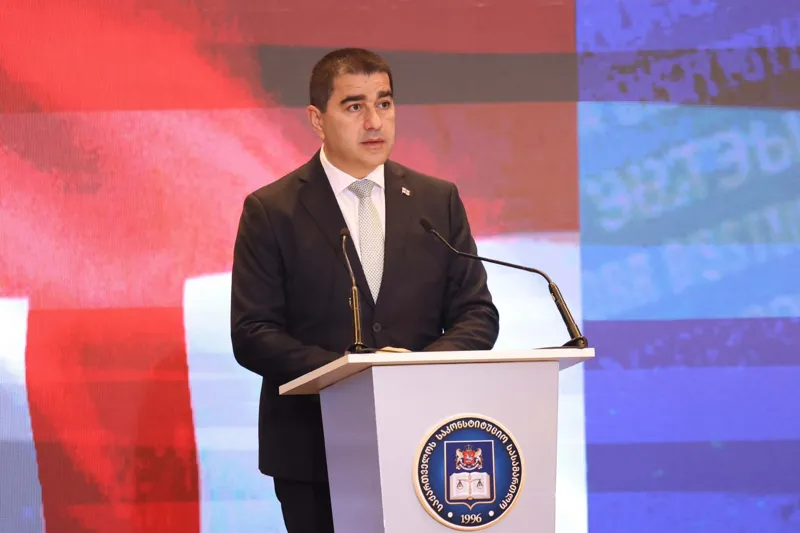
“I congratulate you on the 30th anniversary of the establishment of the Constitutional Court of Georgia. Only some three decades separate us from the time when a state exhausted by civil confrontation, wars, and a devastated economy began to get back on its feet and took its first steps,” said the Speaker of the Parliament of Georgia, Shalva Papuashvili, in his address at the event dedicated to the 30th anniversary of the establishment of the Constitutional Court.
As the Speaker of Parliament noted, after 30 years it can already be said that the Constitutional Court of Georgia is an integral part of the country’s institutional system.
“One of such foundational steps was the creation of the Constitutional Court – an institution that is the guardian of the country’s constitutional order, its interpreter, and the body that delivers the final verdict.
The main significance of the Constitution lies in the fact that the state sets boundaries for its own power – it determines how power is distributed, where the authority of each institution ends, and what constitutes that space of human freedom into which the state cannot intrude.
Therefore, the strength of the Constitutional Court, along with its formal status, lies in its function – to ensure balance between the effective action of the state and the limitations established by the Constitution.
This is especially important for those countries that have had to create and strengthen modern state institutions in a relatively short historical period. In such circumstances, constitutional order cannot be established solely by written norms. It needs institutions that will give substance to these norms, and a political culture that recognizes them as binding rules for everyone.
Protecting the constitutional order means that the state submits to the fundamental rules it has itself established; it means that power is obtained, exercised, and changed by the path established by law; and that followers of different political views compete for public support in a lawful and democratic space. Violation of this order is not merely disagreement between institutions; it endangers the continuity of the state, the rights of citizens, public peace, and the trust on which democracy stands.
Over the course of 30 years, the Constitutional Court has repeatedly found itself faced with issues where law, politics, and state interests stand very close to one another. At such times, the special task of the court is not to shift the weight of the dispute into the political dimension and to leave only the Constitution as the final measure. This is both the difficulty and the importance of constitutional justice – when political confrontation intensifies, the Constitution must be the same measure for everyone.
After 30 years, it can already be said that the Constitutional Court of Georgia is an integral part of the country’s institutional system. During these three decades, the political environment, legislation, state institutions, and public demands have changed, but the main task has remained unchanged – the protection of the Constitution not merely as a text, but as a living norm, rule, and common sense,” Shalva Papuashvili noted.
According to him, the Constitution becomes alive when a citizen sees in it the guarantee of their own rights and freedoms, and the authorities recognize the boundaries it establishes.
“This is the important responsibility of the Constitutional Court in the future as well, because the authority of the Constitution ultimately rests on how capable the state is of renouncing its own power where the Constitution requires it. And that is precisely why a strong Constitutional Court is part of a strong state.
It is precisely this court that must establish those boundaries that neither the state, nor any political party, nor any subject that throughout our recent history has repeatedly attempted to undermine the country’s constitutional order will be able to cross.
I congratulate the Constitutional Court on its 30th anniversary. Thanks to all the judges and staff of the Constitutional Court who participated in the formation and development of this institution. I wish you professional steadfastness and success in the service of the Constitution of our country,” Shalva Papuashvili stated.