A reference to the European Parliament’s October 8 resolution by Giga Lemonjava sparked an argument during a Constitutional Court hearing, with a judge urging him to focus on the case under consideration
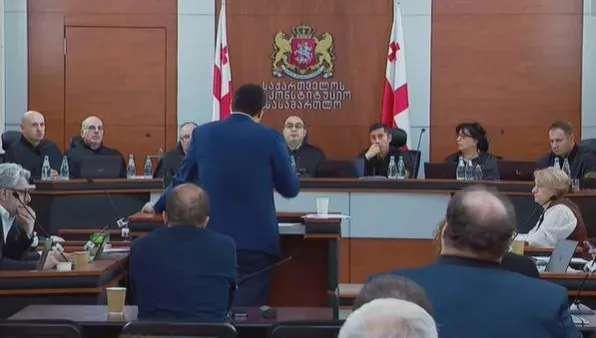
A reference by Giga Lemonjava, a representative of the Coalition for Change, to the European Parliament’s adoption of a resolution on October 8, 2026, and his explanation of its contents sparked a dispute at the Constitutional Court.
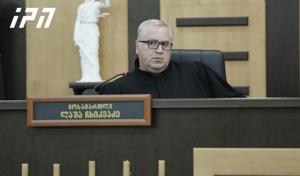
Constitutional Court President Revaz Nadaraia interrupted the representative of the respondent party, stating that the resolution had no connection to the constitutional complaint and that any effort to inform the public about it should take place elsewhere, rather than during the court hearing.
“Mr. Giorgi, what does the October 8 resolution have to do with this case? We are aware of the international context, and everyone knows about this resolution. What does the October 8 resolution have to do with it? It is clear that the resolution was adopted; this is a well-known fact. If you want to inform the public, present it to them elsewhere. The resolution is not relevant to the case. If you want to make it known to the public, do so elsewhere. You are addressing the Court,” Judge Nadaraia said.
His remark that statements made in the courtroom should be directed solely at the Court, rather than at the public, prompted objections from representatives of the Coalition for Change.
“First of all, people do not speak only to the Court during court hearings. The principle of public access does not mean that a courtroom hearing consists solely of a dialogue with the Court,” Nika Gvaramia said.
Judge Revaz Nadaraia then explained what public access to court proceedings means and told Gvaramia that he was disrupting order.
“Mr. Nika, people speak only to the Court during a court hearing! That is entirely appropriate, Mr. Nika, and you should know that people address the Court in a courtroom.
Public access means that everyone can follow the hearing, not that people can make political statements. You are interrupting me and disrupting order! If the Court has to explain what a public hearing is, I will explain it. A public hearing means that all members of society are given the opportunity to watch and follow the statements made during court proceedings. But that does not mean you can use the courtroom as a platform to address the public. People speak from the Court’s podium solely about matters relevant to the case and address the Court alone, because the only body empowered to make a decision here is the Court, not the public.
The public is being informed. I urge Mr. Giorgi to speak about matters relevant to the case before the Court. The resolution that was adopted is very well known, but these are political developments and have no bearing whatsoever on the specific constitutional complaint,” Judge Nadaraia said.
In his closing statement, Giga Lemonjava cited examples of international reactions to efforts to ban opposition parties, including the European Parliament’s resolution, to illustrate the international context.
“On October 8, 2026, five days before the substantive hearing of this complaint, the European Parliament adopted a resolution by an unprecedented majority of 445 votes, condemning the ruling Georgian Dream party’s efforts to ban opposition parties in Georgia and calling for the immediate withdrawal of the lawsuit seeking their prohibition.
The proceedings were described as part of a strategy to eliminate legitimate political opposition, eradicate political pluralism and turn Georgia into a one-party regime. They were compared to the Russian and Belarusian models, with the resolution noting that they served the Kremlin’s objective of keeping Georgia outside the European and Euro-Atlantic space,” Lemonjava said.