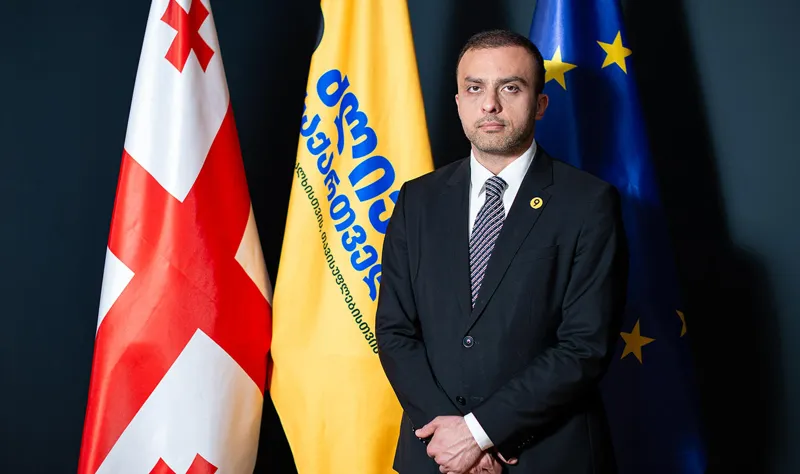
Archil Gorduladze: For two days now, the "collective National Movement" has been revealing its true face; they lack any legal arguments; They question why five parties are being tried together - the answer is simple: they have been together since foundation and share an ideological unity
For the past two days, the "collective National Movement" has been showing its true face. They have no legal arguments to demonstrate why they are not unconstitutional; in fact, they lack even political arguments - despite their persistent efforts over these two days to shift the legal process into a political context. This was stated by Archil Gorduladze, Chairman of the Parliament’s Legal Issues Committee, while speaking to journalists.
According to him, the only point the opposition parties raise is why five parties are being tried together.
“The answer here is very simple: they have been together since the very day they were formed. They share an ideological unity and act as one—for instance, in their efforts to overthrow the constitutional order, in their attempts to delegitimize the system, in their refusal to recognize elections, and in their boycotts—and this includes the "Gakharia faction" as well. We must not forget that the "Gakharia faction" did not even enter Parliament for an entire year; and what were they waiting for? They admitted themselves that they were waiting to see how October 4, 2025, would unfold. Their primary crime against this country is the attempt to overthrow the constitutional order—or to seize power through violence—undermining democracy, and infringing upon the country’s independence through treacherous actions related to its territory. They share the same nature; therefore, as parties that are closely interconnected, they will be tried together. We will do everything in our power to provide a legal justification for why their dissolution—and, consequently, their declaration as unconstitutional—is necessary. The collective "National Movement" does not consist of just one, three, or five separate parties; rather, these are forces—fragmented into so-called "parties"—that share a single ideology and are controlled from a single source. They act against the constitutional order and the will of the Georgian people, often carrying out instructions from external patrons. For instance, Saakashvili writes that they traveled abroad under the auspices of the IRI, where foreign actors urged them to unite. While some reached an agreement and others did not, the core issue was whether they should unite openly and explicitly around a certain odious figure—a destructive agent—or maintain a covert alliance. The main point is this: the collective 'National Movement' will attempt to carry out instructions received from the outside—something the Georgian people will always, without exception, oppose," noted Archil Gorduladze.
Speaking to journalists, Gorduladze also addressed international reactions regarding the process of banning political parties. He remarked that "forces standing behind various bureaucracies abroad—whether elected or unelected—are trying to save their agents; otherwise, other agents might lose the desire to obey their masters."
He further added that "it is a catastrophe when a Vice-President of the OSCE Parliamentary Assembly campaigns against the justice system."
"When I speak of the collapse of the rule of law, I mean, among other things, that everyone must respect our country’s Constitution, legislation, and internationally recognized standards. One such principle is the right to seek recourse in court; yet, this official is now telling us that we should not exercise a right that is provided for and enshrined in both our Constitution and the European Convention on Human Rights. This is nothing more than an attempt to exert pressure on an independent judiciary. Various foreign officials—including, at times, the so-called ambassadors of certain countries—persistently attempt to make statements regarding criminal or administrative cases; they have even gone so far as to have ambassadors sit directly in on court proceedings. Such attempts at pressure have never succeeded in the past, nor will they succeed in the future. At the same time, we will always raise our voices in defense of the fundamental principles for which the Council of Europe was established—principles that the European bureaucracy is currently trampling underfoot," noted Archil Gorduladze.