Giorgi Melashvili: We already went through this once in 2006. Russia’s interests are unchanged – it wants the subjugation of Georgia and for this it uses every lever. The way to reduce the threats is the solidarity of European partners
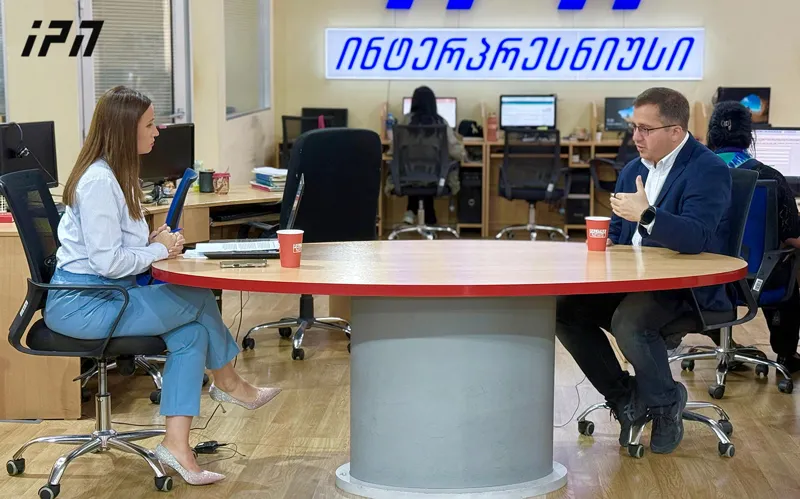
Russia is demanding from Georgia, in exchange for the economic benefits that “Georgian Dream” had, the taking of political steps and the de facto recognition of the occupied regions, Giorgi Melashvili, head of the European-Georgian Institute, stated while appearing as a guest on PalitraNews’ programme “Day’s Newsroom,” speaking about Russia’s ban on the import of a number of products produced in Georgia.
According to him, “Georgian Dream” created greenhouse conditions for Russian money, which further increased Georgia’s economic dependence on Russia. Melashvili notes that against the background of isolation from Western partners, Moscow decided to use for its own benefit those economic levers that the authorities had granted it over the years.
“The standard of Georgian products is in no way inferior, and I think that a number of producers, on the contrary, exceed Russian criteria. We already went through this once in 2006. Russia’s interests are unchanged – Russia wants the subjugation of Georgia. For this it uses every lever, whether military, political or economic, against our country. ‘Georgian Dream’ created greenhouse conditions for Russian money in Georgia, thereby contributing to the further growth of the Georgian economy’s dependence on Russia. We were also warning then that this was destructive and dangerous. As a result of ‘Georgian Dream’s’ completely inadequate foreign policy, at a time when we are isolated from Western partners, Russia decided to make even greater use of those levers that ‘Georgian Dream’ granted Russia over these decades. We have already seen that Russia imposed even worse sanctions with regard to Armenia, yet the West lifted a whole series of regulations and approximately 80% of Armenian products can enter the European market without additional taxes. That is, communication with European partners, their solidarity, is the main way to reduce this threat. Unfortunately, ‘Georgian Dream’ does not have the adequacy to speak healthily with the West on Georgia’s behalf. During this time we saw from them concessions toward Russia, while toward the West we see the adoption of autocratic laws. The whole tragedy of this governance is that they do not know how global processes are unfolding and, in the end, with these actions they have sharply reduced Georgia’s resilience,” Giorgi Melashvili stated.
As for the statement of the Russian foreign ministry that implied the provision by Tbilisi of guarantees of non-use of force toward Sokhumi and Tskhinvali, Melashvili noted that this is a red line “the crossing of which even ‘Georgian Dream’ does not have the resources for.”
“The signing by the Georgian side of this agreement would mean the recognition of the occupation, which directly contradicts Georgia’s national interests; even ‘Georgian Dream’ understands this. This is a red line even for Georgian Dream, despite all their ‘Russophile’ policy, and I do not think that they possess the ability to cross it today. We have reached the situation where Russia, in exchange for the economic benefits that ‘Georgian Dream’ had, demanded the taking of political steps, which implies that we cut off these two regions and hand them over to Moscow. If Tbilisi signs any agreement with Sokhumi or Tskhinvali, this automatically means raising their status and de facto recognition,” Melashvili explained.
In addition, according to Giorgi Melashvili’s assessment, “a reset of relations with the West is still possible by abolishing anti-democratic laws and releasing political prisoners; otherwise ‘Georgian Dream’ faces a real threat of sanctions.” As he noted, the European Union now has far more levers for pressure on the authorities.
“Integration into the European Union means increasing the protection of Georgia’s sovereignty, a step toward the protection of our identity, and economic integration. Taking all of this into account, no surrender of sovereignty occurs through accession; on the contrary, Georgia will have the opportunity to become part of that political, economic, social and cultural space of which we are mentally already a part. If Georgian Dream really wants a reset of relations with Europe and America, let them abolish the anti-democratic laws, stop the anti-Western rhetoric and release the political prisoners. After that, communication with the West will become possible. Until now ‘Georgian Dream’ had Orbán, who blocked decisions taken in the EU zone; now Orbán is no longer there, accordingly the European Council has far greater possibility to use all the levers at their disposal. The European Union said from the very beginning that it does not want to punish the Georgian people; at this stage we see that there are still no graduated sanctions that would directly affect a Georgian citizen. Everything is on the table – it will depend on Georgian Dream whether more painful decisions for them are taken. If they say they are not afraid of sanctions, let them look at Mr. Rukhadze,” Melashvili stated.