Prosecutor: There was no discrepancy whatsoever in the testimonies. Both Mamuka Bakhtadze and Vakhtang Gomelauri were categorical - it was once again confirmed that the checkpoint in Chorchana was built as a unilateral decision by Giorgi Gakharia
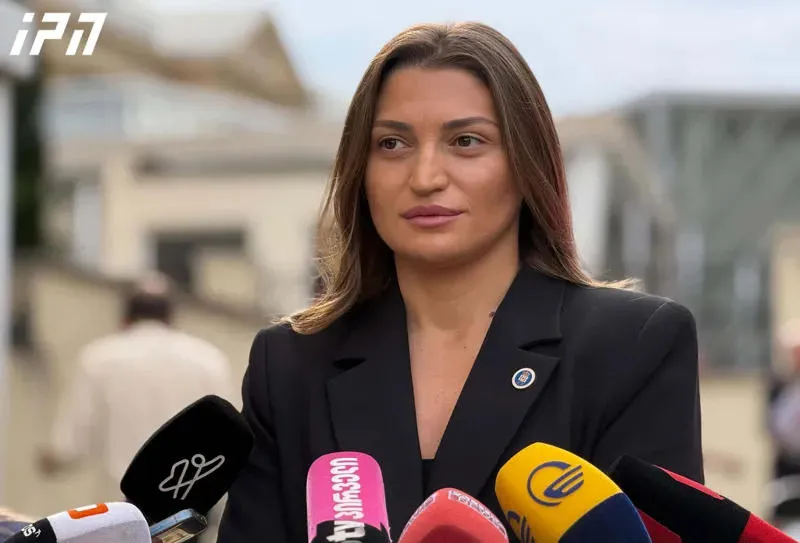
“Vakhtang Gomelauri’s testimony once again confirmed that the checkpoint in the village of Chorchana was built as a unilateral decision by Giorgi Gakharia,” Tamar Iakobidze, the prosecutor in the case against former Interior Minister Giorgi Gakharia, who is charged in the so-called Chorchana case, said.
As Iakobidze explained, today’s testimony by former head of the State Security Service Vakhtang Gomelauri confirmed that the agency was not aware of the construction of the checkpoint and learned about it through the hotline.
“The decision in question was not coordinated with the State Security Service. Moreover, the State Security Service was not informed about the establishment of the checkpoint. As you know, within the framework of the Incident Prevention and Response Mechanism with the European Union Monitoring Mission, the State Security Service is the main negotiator. Today’s court hearing once again confirmed that even the European Union Monitoring Mission had not been informed about the establishment of the checkpoint,” Iakobidze said.
According to her, there was no discrepancy whatsoever between the testimonies of former Prime Minister Mamuka Bakhtadze and former Interior Minister Vakhtang Gomelauri.
“There was no discrepancy whatsoever. In this case, the witness spoke categorically about the events that unfolded before August 24, 2019, stating that he had had no communication with [Giorgi Gakharia] regarding the establishment of the checkpoint. This testimony was also confirmed by Mamuka Bakhtadze, who said that he had had no communication with him [Gakharia]. I cannot tell you what discrepancy the defense is talking about. Both witnesses were categorical - both the prime minister at the time, Mamuka Bakhtadze, and the State Security Service said that they had no information about the establishment of the checkpoint.
Vakhtang Gomelauri stated during the court hearing that road construction works did not automatically indicate that a checkpoint was being established. The witness said that the roadworks were not a one-time undertaking but were carried out repeatedly in different areas, often with the purpose of enabling mobile patrols to move around and providing certain conveniences for the local population. As you know, the European Union Monitoring Mission constantly patrols and moves along the occupation line, so the existence of roads was an important factor.
As for when the State Security Service learned about the establishment of the checkpoint, the agency found out when construction of the checkpoint began. The State Security Service learned about it specifically through the hotline. This testimony is consistent with that of another witness, Irakli Antadze, a representative of the State Security Service’s Analytical Department. He also confirmed that the information was received through the hotline and that as soon as the notification was made, the State Security Service immediately began responding.
The checkpoint had not yet been completed. Construction was underway, with a flag and other attributes already installed on it, creating the impression that a checkpoint was being built.
The second witness was Levan Kakava, who was Giorgi Gakharia’s deputy when Gakharia was Interior Minister. There were certain documents that he had signed. In this case, these were documents related to road rehabilitation. Nowhere in those documents did it state that the purpose of repairing the road was to establish a checkpoint. Since this was not stated in the documents, we were interested in whether he [Gakharia] had personally communicated with his deputy about it. However, the witness categorically ruled out that he had known anything about the establishment of the checkpoint,” Iakobidze said.
For reference, former Interior Minister and former Prime Minister Giorgi Gakharia has been charged in the so-called Chorchana case under Article 333, Part 2, which concerns the abuse of official powers by a political officeholder and carries a sentence of three to five years in prison.
According to the indictment, Giorgi Gakharia unilaterally decided to establish an additional police checkpoint near the village of Chorchana along the occupation line. As a result, approximately 100 hectares of forest came under the control of the occupying forces, various illegal activities took place, heavy military equipment moved toward populated areas, and the homes of residents of the Kobi and Tsnelisi villages in Khashuri Municipality also came under the control of the occupying forces.