Giorgi Rukhadze: Sanctioning judges is an acknowledgment that we do not have a free judiciary – The U.S. demand will likely be the release of prisoners and securing a 'Democratic Mandate,' which requires new elections
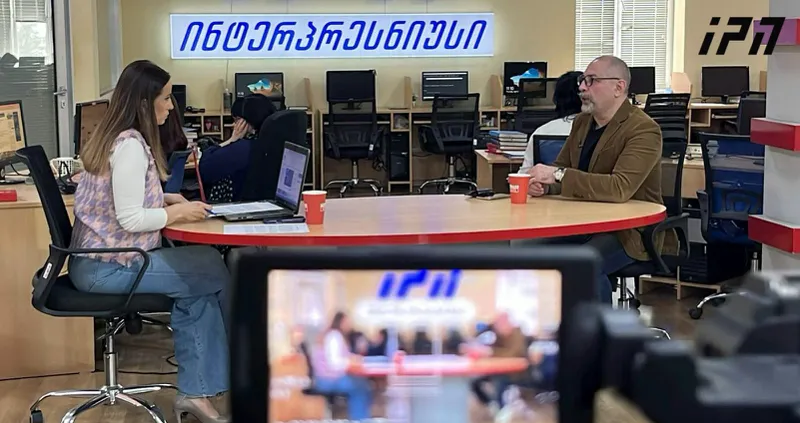
"It is very good that Murusidze and Chinchaladze have felt the impact of sanctions on their own skin; their bank accounts have been blocked. They will likely try to find some workaround, and Murusidze will somehow manage to receive his salary. However, he won’t be able to travel to Europe, the UK, or the U.S.—he will just wander around his village, and that will be his life," said Giorgi Rukhadze, founder of the Strategic Analysis Center, during his appearance on Palitra News' program "Day’s Newsroom."
Rukhadze was commenting on the UK’s decision to impose sanctions on judges Mikheil Chinchaladze and Levan Murusidze.
According to him, sanctioning judges is a clear declaration that there is no free judiciary in Georgia.
"A sanctioned judge means exactly that. Why Murusidze and Chinchaladze? Because they are the backbone of the judicial clan. This is a direct attack on the fact that the judiciary is not free, it is corrupt—not necessarily in the sense of taking bribes, as corruption has a broader meaning than just financial gain.
When the government tells you to appoint a certain person to a specific position and you comply, whether you take money for it or not, it is still corruption. This was a timely decision, and it is very good that Murusidze and Chinchaladze have felt the consequences firsthand—their bank accounts have been frozen."
Rukhadze noted that, of course, sanctioned individuals will look for alternative ways to function, but the main issue is not whether Murusidze will receive cash payments or get money through an exchange office.
"He will surely find some crude workaround to receive his salary. Naturally, his salary itself is not at risk, but he will still need to make transactions. He will no longer be able to use the banking system, and let’s not forget that 80% of financial operations in Georgia's banking system go through two British banks. Yes, all sanctioned individuals will find some loophole, but Murusidze will no longer be able to travel to Europe, the UK, or the U.S.—he will just be stuck in his village, and that will be his life."
During the program, Rukhadze also discussed other pressing issues, including the U.S. State Department’s recent statement, which called the actions of the Georgian Dream government anti-democratic.
"The Ivanishvili regime is an undemocratic regime. The State Department stated that a democratic mandate cannot be obtained in this way, meaning Ivanishvili’s regime does not have a democratic mandate.
So how is a mandate obtained? Not by suppressing political opponents and free speech, but by respecting the will of the majority of the population. The statement also suggests that there has been direct communication between the U.S. and the Ivanishvili regime, where American officials presented their demands regarding the reset or improvement of U.S.-Georgia relations.
This is not an exceptionally harsh statement, but the outlines are clear: the new U.S. administration demands democracy and respect for democratic principles in Georgia. They also demand an end to arbitrary arrests—whether it be against political opponents of Georgian Dream or ordinary protesters on Rustaveli Avenue.
Although not stated explicitly, this gives me reason to believe that one of the key U.S. demands will be the release of political prisoners, and another will be securing a democratic mandate. And the only way to achieve that is new elections."
However, Rukhadze pointed out that at this stage, the Georgian government had no intention of holding new elections. Instead, they are launching a new wave of repressions and enacting draconian laws.
"The so-called president has already signed a new 'Russian law' that will affect all of us—individuals and commercial organizations alike."
Rukhadze also commented on Georgian Dream’s propaganda strategy, which portrays the U.S. in a contradictory manner.
"The so-called 'defeat of the deep state' is nothing more than a mind-washing operation for Georgian Dream voters.
If the new U.S. administration does something that benefits Ivanishvili’s regime, they will say, ‘Bravo! They stood up to the deep state and the war party.’
If, on the other hand, the U.S. does something that is harmful to Ivanishvili’s regime, they will claim, ‘See? They are also bad, and they are part of the deep state.’
This is simple propaganda aimed at brainwashing the domestic audience," Rukhadze concluded.