


Salome Zurabishvili: Georgia remains Pro-European, sharing common values with Europe
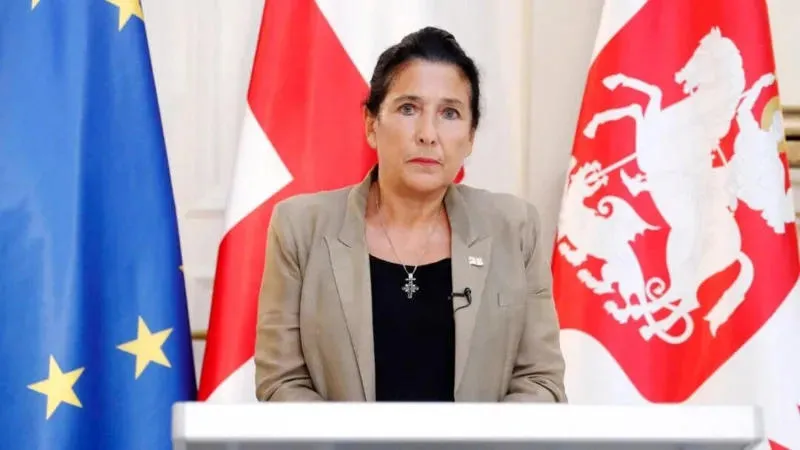
The President of Georgia, Salome Zurabishvili, reaffirmed Georgia's pro-European stance, emphasizing the shared values between Georgia and Europe, which shape the country's European destiny. Zurabishvili made these remarks during the opening of the documentary "Abkhazia Before Bucha" at the National Assembly in Paris on the 31st anniversary of the fall of Sokhumi.
Speaking about Georgia's ongoing struggle, she sharply criticized the current government, claiming that under Bidzina Ivanishvili’s leadership, the government has "practically declared war on our 30-year-old partners and friends to align with Moscow."
"We are gathered today, on this tragic day for Georgia, September 27, the day of the fall of Sokhumi. The fact that we are gathered here in Paris, the capital of Europe, alongside the European Minister, symbolizes the long journey Georgia has undertaken since independence. This journey was marked by immediate war, which Russia framed as a conflict between Georgia and Abkhazia. In reality, it was a war initiated and embraced by Russia, a precursor to the brutality we witnessed in Bucha, Ukraine," Zurabishvili said, drawing parallels between Russia’s actions in Abkhazia and its current invasion of Ukraine.
Zurabishvili further criticized the current Georgian government for its controversial election campaign, which juxtaposes images of war-torn Ukraine with Georgian symbols. "The government thought it was appropriate to display banners showing the ruined Mariupol theater alongside a restored Georgian theater, and images of the destroyed Ukrainian cathedral next to the Holy Trinity Cathedral in Tbilisi. This provoked outrage across the population, even among supporters of the 'Georgian Dream' party, and stands in stark contrast to Georgia's traditions, culture, and humanity," she stated.
The President stressed that Georgia’s European destiny is rooted in shared values, and despite historical conflicts, the country has never wavered from its commitment to European integration. "Polls consistently show that 80-85% of Georgians support Europeanization. Despite conflicts that could have led to calls for reconciliation with Russia in exchange for lost territories, Georgia has never abandoned its European path."
Reflecting on the country's progress since the 1990s, Zurabishvili pointed to key milestones such as the Association Agreement, visa liberalization, and Georgia's progress toward European Union candidate status, achieved in part due to Ukraine’s struggle. She acknowledged the accelerated timeline for candidacy, stating, "We owe this advancement to Ukraine and its fight for freedom."
Zurabishvili sharply criticized the increasing anti-European rhetoric from the Georgian government since January 2024, accusing the Ivanishvili-led administration of aligning with Moscow at the expense of Georgia’s pro-European aspirations. She condemned the government's claims that Europe and the U.S. were attempting to open a "second front" in Georgia, stating that Russia has always been the aggressor in the region.
"The October 26 elections are vital. The outcome will determine whether Georgia returns to its European path or faces a tragic future, not only for itself but for neighboring Armenia and the wider Caucasus region," she warned. Zurabishvili concluded by calling on Russia to respect its borders and its neighbors, stressing that peace, prosperity, and regional development can only be achieved when Russia becomes a "normal state."










