


Ambassador of Estonia to Georgia: You cannot come and say: I want to become a member of the club, but I have my own rules - nobody wants to punish society, but we must show that this is the result of not following the rules of the game
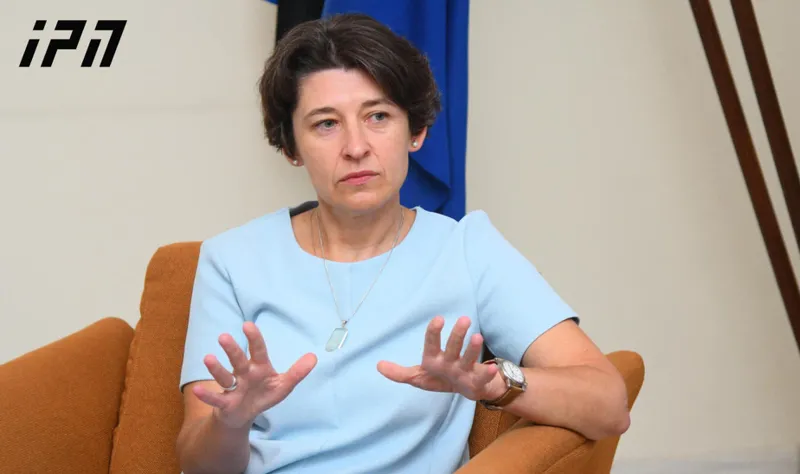
We cannot always compromise when any Government passes any kind of law. You cannot come and say: I want to become a member of the club, but I have my own rules. It doesn't work like that, Riina Kaljurand, the ambassador of Estonia to Georgia, said in an interview with InterpressNews.
In response to a question about the possible consequences of the statement received by the Riigikogu (Parliament of Estonia) regarding Georgia, in which it condemns the actions of the Georgian Government and the Parliamentary majority regarding the adoption of the law "On the transparency of foreign influence" and the "abandonment of European values", the diplomat noted that the issue of Georgia by the Parliament of Estonia is on the agenda and the developments in the country are important for them.
Riina Kaljurand also said that the discussion regarding Georgia will be held in the European Union at the end of the month, where the union will discuss the country. The ambassador emphasized that the European Union is not interested in punishing the Georgian people.
"We don't know what can be done, what can't be done. There are things you can do, there are things you can't. All this will be discussed at the end of this month both at the Council of Foreign Ministers and at the European Council in Brussels. All member states are involved and all options are on the table. Estonia is very vocal about some options. It is also important that the European Union protects its interests and those of its member states. We cannot always compromise when any government passes any kind of law. I think that the EU as a whole can only protect all member states if we all follow the same rules. You cannot come and say: I want to become a member of the club, but I have my own rules. It doesn't work that way. Unfortunately, some events can be quite painful for the public as well. No one wants to punish society, but we must show that this is the result of not following the rules of the game. The Georgian people, who aspire to join the European Union, make up 85% of the population, the Georgian Government has an obligation to fulfill the wishes of these people and play by the rules," said Riina Kaljurand.
When asked how fair it would be to cancel the possibility of visa-free travel to the European Union for the population of Georgia, the ambassador said that visa freedom is part of Georgia's privileged relationship with the European Union and it also requires the fulfillment of certain criteria.
"Many may not like this. Is it clear. On the other hand, visa freedom is part of Georgia's privileged relationship with the European Union and it also requires the fulfillment of certain criteria. We see that due to the created situation, too many people are leaving the country. The number of asylum seekers in Europe has increased. Many of them enter Europe illegally. This is the bad side of this policy. It's more like a tool again, to show that whatever progress you make on this road to the EU, you have to keep it going.
The EU is a set of rules, a way of life, not a charity. If this way of life and these values are unacceptable for any reason, the EU also has the right to change this privileged relationship. It has nothing to do with people, although people will be hurt. But then, eventually, people will have a choice. Elections are coming and it is up to the Georgian people. A visa suspension should never be implemented, but it is a real tool. And it can change because it's a technical issue. It only needs a majority (qualitative majority) vote, and Estonia puts this issue on the agenda as an option. We do not know whether it will have the support of other member states. But we see that this is one of the realistic options that can be done. This is not against the Georgian people, but it is something that arose as a result of the policy of the Georgian Government," the ambassador said.










