


Shalva Papuashvili: I am sure that, like all disinformation campaigns, time will show that its goal is to strengthen the resilience of Georgia, which is facing challenges
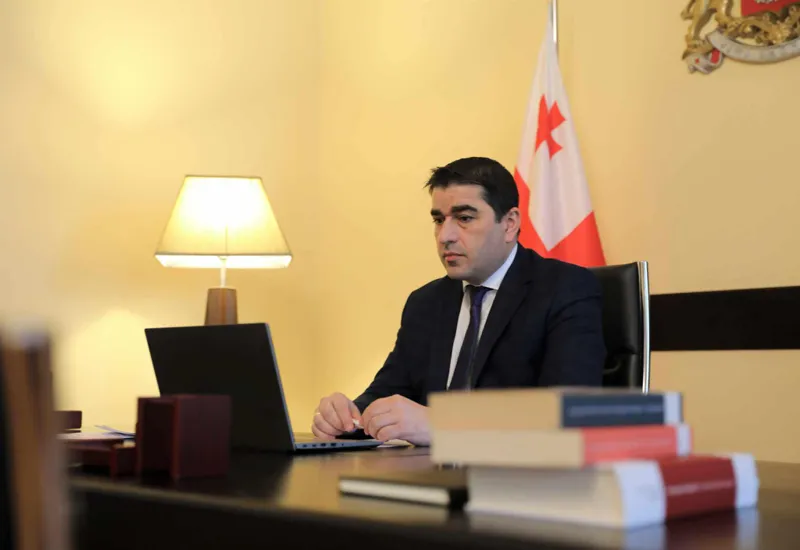
I thank you for the opportunity to address you today, to assess the current events in Georgia and shed light on the many times stigmatized issue - covert foreign intervention poses a threat to the national interests of many countries around the world, - said the Speaker of the Parliament of Georgia, Shalva Papuashvili, during his speech at the meeting of the Standing Committee of the Parliamentary Assembly of the Council of Europe. .
The Chairman of the Parliament of Georgia spoke about the challenges facing Georgia and noted that in the face of the mentioned danger for the country, it is necessary to respond.
"I thank you for the opportunity to address you today, to evaluate the current events in Georgia and shed light on the issue that has been stigmatized many times. Covert foreign interference threatens the national interests of many countries around the world. In response, these countries are sparing no effort to deal with this growing problem and to strengthen their political, economic and security systems. In this regard, Georgia is not an exception. Georgia's geopolitical location and complex regional situation further complicate the situation and make the country and society more vulnerable. At the same time, we often see hidden schemes to encourage polarization and undermine state institutions. Against this background, we do not have the luxury of being inactive. On the contrary, in the face of the mentioned threat, a response is a necessary need. If non-profit organizations in Georgia are involved in decision-making at all levels and have the opportunity to influence public life, they must meet the basic standard of transparency - the population must know who is behind each actor. This is true of state institutions, political parties, and civil servants, and it should be true of non-profit organizations as well. Financial transparency of all these key actors in the decision-making process is a basic principle. Despite many attempts over the past year to convince international donors and local organizations to voluntarily provide transparency to the public, all efforts have been unsuccessful. Despite acknowledging the shortcomings and legitimate concerns, no steps have been taken to improve transparency. "The law on transparency of foreign influence deals with this problem of opacity of foreign influence with uniform and proportional steps, with full respect for fundamental human rights and political freedoms," said the Chairman of the Parliament. According to him, internal and external actors have unfortunately stigmatized the law of transparency.
As Papuashvili noted, the analogues of the international law are much stricter, since their legal records are more rigid than the Georgian version. From the very beginning, the label of "Russian" was attached to the law. In fact, the "Russian law" is a mouth-watering political metaphor intended to stigmatize the legislation and cause public unrest. In fact, whether one likes it or not, other international counterparts are much stricter, since their legal records are more rigid than the Georgian version. Moreover, there is no wording of "foreign agent" in Georgian legislation; Instead, the term "organization representing the interests of a foreign power" is used. It is similar to the EU term "organization representing interests on behalf of third countries", which we find in the draft directive developed by the European Commission. We have studied the practice of the European Court of Justice and the European Court of Human Rights and we believe that the Georgian law is in compliance with international human rights standards. It does not impose any restrictions on foreign financing or access to foreign funds; It does not require prior permission for financial transfers; It does not include funding controls or administrative dissolution; And it does not establish criminal liability. The law does not restrict non-profit organizations in any way from seeking, receiving or using foreign funding, as well as legitimate activities related to the promotion of human rights and democracy. In Georgia, non-profit organizations are free and will be free even after the adoption of the law. The Foreign Transparency Act imposes a single simple obligation for non-profit organizations with more than 20% of their revenue to come from foreign funding to declare their finances once a year. The law applies only to organizations and not to individuals. This is the most minimal and proportionate intervention. There is no lesser commitment to transparency in any legal space worldwide.
The Foreign Influence Transparency Law will increase the level of responsibility and accountability of nonprofit organizations. It will improve the political and electoral systems in Georgia and will enable more inclusive participation of non-profit organizations in the process of policy development," said Shalva Papuashvili.
The Chairman of the Parliament also spoke yesterday about the decision issued by the European Court of Human Rights, which, according to him, rejected the speculations abou Mikheil Saakashvili. "It is precisely for these reasons that we do not share the opinion of the Venice Commission. Finally, it is not clear why transparency can be undemocratic or un-European. Therefore, we will overcome the veto of the President of Georgia regarding the mentioned law. Spreading disinformation against Georgia It is not new to us. One such outstanding example of disinformation was the criminal prosecution of former President Mikheil Saakashvili. Yesterday, the European Court of Human Rights ended all speculations regarding his so-called "political imprisonment". This myth was repeatedly mentioned in the resolutions and statements of various organizations and politicians. In 2022, even the Parliamentary Assembly of the Council of Europe adopted Resolution 2463, where Saakashvili is referred to as a "political prisoner" without any argumentation. Therefore, it was not surprising that yesterday's decision of the European Court of Human Rights lifted the curtain on myths and misinformation about Saakashvili and all those related to him. About the resolution. Time has clearly shown that despite aggressive disinformation campaigns, Georgia and its institutions are on the path to democratic consolidation. I am sure that, like all such disinformation campaigns, time will show that its only purpose is political, economic and maintaining the strength of security systems and strengthening the resilience of Georgia facing challenges. We are always ready for a constructive and fact-based dialogue, as well as listening to critical assessments," said Shalva Papuashvili, participating in the session of the Standing Committee of the Council of Europe.










