UN Resident Coordinator in Georgia Sabine Machl: We need to reform the United Nations - it's a very different world today compared to when the UN was created
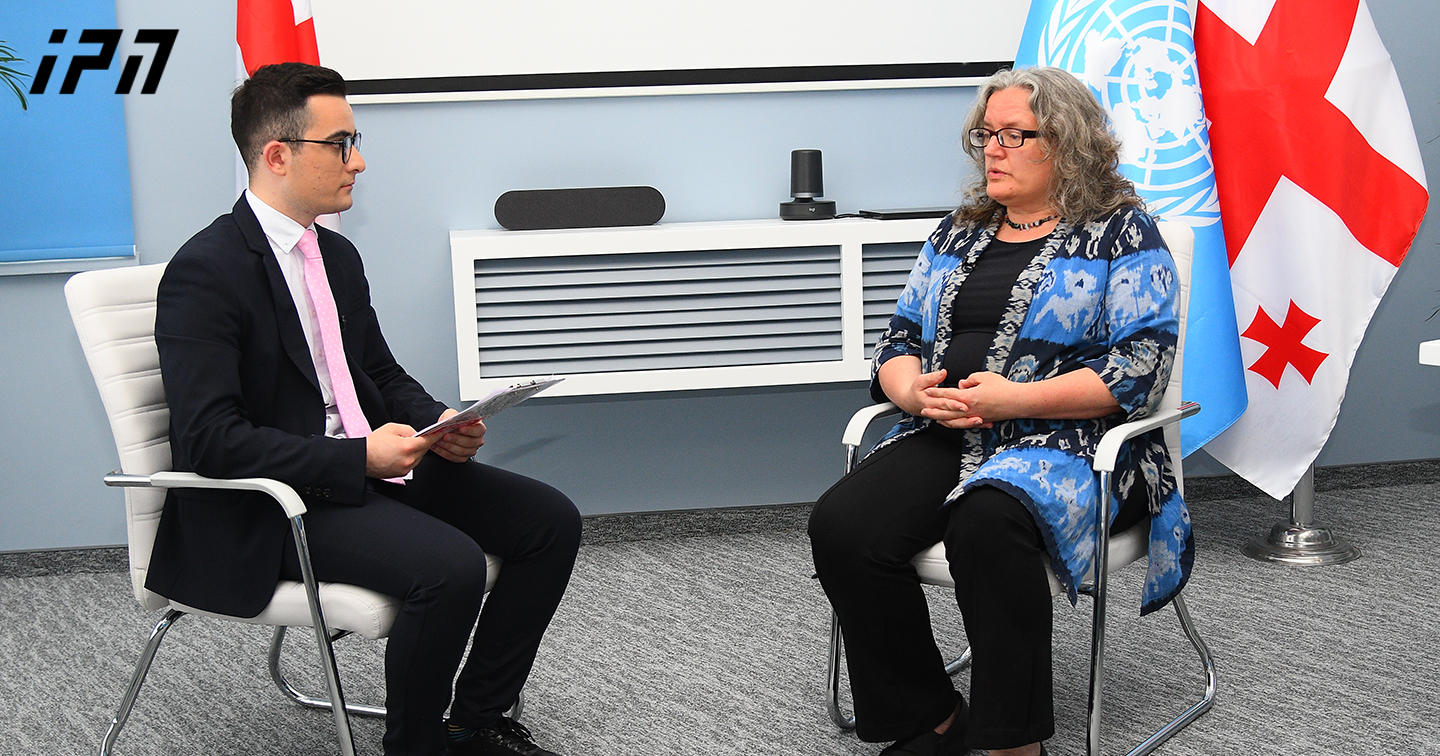
According to Sabine Machl, the United Nations Resident Coordinator in Georgia, the UN needs to be reformed to make it much more adaptable and also relevant to the current context. As Sabine Machl notes, throughout the existence of the UN, there have been failures, however, there have also been good stories where the organization provided real help.
Reforming the UN Security Council, Russia's invasion of Ukraine, the role of the UN in resolving the conflict in Georgia and the peace process, 31-year partnership between Georgia and the UN, implementation of the 17 Sustainable Development Goals, and youth empowerment - the UN Resident Coordinator in Georgia Sabine Machl spoke about these and other issues in an exclusive interview with InterPressNews.
The major objectives of the United Nations are the maintenance of international peace and security, however, there are a number of ongoing conflicts taking place around the globe. How successful is the UN in terms of solving the existing disputes and hostilities globally?
Thank you for this question. Yes, how successful we are? I think the UN is as strong and as successful as the 193 member states want it to be. And you are right. Since its inception in 1945, we have the United Nations Charter. Its idea was to prevent conflicts from occurring, to sustain peace, and to also support resolving issues of parties in conflict. We should feel heartened by all that has been achieved. Unfortunately, as you said, we are seeing still many, many of the conflicts. And the most recent Russian invasion of Ukraine has also shown to inflict so much suffering on people and we – as a global body, as the United Nations – are still there trying to find solutions. Our Secretary-General has repeatedly said that this war must end in compliance with the United Nations Charter.
Yes, I would like to ask you about the United Nations’ efforts to end Russia's horrific war in Ukraine. Do you think that the UN failed to uphold international law when Russia, one of its Security Council permanent members, launched a brutal full-scale invasion of a sovereign neighboring country?
I think it is very important to have the United Nations as a global body. And, of course, we have seen throughout its history that the UN Charter was broken, unfortunately, and in this case as well, as you said. But I still believe it's significant to have an international order. It is very important to also uphold it even more now, because when the United Nations was created, we were in a different world. Nowadays, we have much more globalization. We are in a digital age where so much is going on the social media and the internet. I think it's even more important to find a way of how to stay relevant. And this is one thing that our Secretary-General has said, but also before him, Mr. Ban Ki-moon, and even before him, Kofi Annan in 2005, we need to reform the United Nations in order to become much more adaptable and also relevant to the current context. It's a very different world today compared to when the UN was created. And therefore, I think it is important that there are discussions going on about how we can make sure the UN remains relevant.
There were failures, yes; I think you're right. But there were also good stories where the United Nations has actually helped. We are probably best known for peacekeeping operations, right? I mean there have been over 2 million people that have participated in peacekeeping operations throughout the years globally. As mentioned, in many of the conflicts where the United Nations is involved, there are also good stories. It's not the failure throughout. We need to really see what we can do as a global player in maintaining peace and also preventing conflicts. Mr. Guterres is very strong on prevention. He really wants us to prevent conflicts from occurring by investing in this before the conflicts break out. I think that's very, very important - having everybody included in finding solutions to that.
You have already mentioned the need to reform the UN, but we will touch upon this issue thoroughly a bit later. Before, I would like to ask you, how should the UN hold Russia accountable for its atrocities and apparent war crimes committed in Ukraine?
There are several investigations going on and currently, we, as the UN, are assisting those people in Ukraine who need our help. For instance, the most vulnerable are even more impacted by the war, like children or the elderly or poor people. There are currently about 8 million refugees outside Ukraine. We have over 5 million people inside Ukraine that are being displaced. The UN is trying to support whatever we can from the humanitarian perspective. You have maybe also heard about the Black Sea Grain Initiative and the Russian food and fertilizer deal brokered by the UN in July 2022. So these are all things where we are trying to mitigate some of the fallout of this terrible war that is currently ongoing. So basically, this is what our colleagues are doing in Ukraine; we are trying from a humanitarian perspective, but also in terms of how we can support any sort of platforms to address and deal with the fallout of this war.
Last month, while visiting Hiroshima, Japan, U.N. Secretary-General Antonio Guterres said that it was time to reform the Security Council to align with the "realities of today's world". Can we describe the UNSC as an outdated and dysfunctional body, which is unable to cope with its key role to ensure international peace and security?
As we said earlier, I think you're right. I mean, when the UN was created with the five big powers in the Security Council at the time, everything was geared towards no more interstate wars. And today, we see that there are so many other threats. There are internal wars, civil wars going on. We have to deal with terrorism, we need to prevent all sorts of extremism and many other things. Our Secretary-General has asked the member states to look into what the options are on how we could reform the United Nations in all its governing bodies and what would be the best way forward in holding those accountable that are actually breaching the charter. For instance, there was an idea for having even more permanent members of the Security Council. This could be one option, or you could also see more rotational functions. I mean, there are a lot of opportunities, and this is for the member states to discuss and to find a solution. But it's very important to discuss it and to make the UN fit for how we can support the countries where we work in the best manner and work towards our common agenda.
Sustainable Development Goal number 16 in the 2030 agenda about peace, and also number ten – which is about inequalities – are crucial. We must make countries more equal, not less equal. So, in short, this is definitely a crucial discussion led by member states. And we can come in as United Nations civil servants with ideas, maybe proposals. Our colleagues in New York, I think, are also looking into options. But in the end, the decision is with the 193 member states of the United Nations.
Let’s move to Georgia. How can the United Nations contribute to the conflict-resolution and peacebuilding process between Georgia and the Russian-occupied territories of Abkhazia and South Ossetia/Tskhinvali Region?
You probably know about the Geneva international discussions, which are happening three to four times per year in Geneva, where issues related to Abkhazia and South Ossetia are discussed. It is a discussion that is co-facilitated by the United Nations, the European Union, and the OSCE (the Organization for Security and Co-operation in Europe). This is one of the avenues where these difficult issues are being discussed. There are usually two working groups. I usually participate in working group II, which deals with humanitarian issues and the needs of the people there. Working group I focuses more on security aspects and status questions. So I think this is a very important forum to continue discussing solutions and transformation of this protracted conflict.
Do you think that the Geneva discussions are fruitful and it can have some tangible results regarding conflict transformation in Georgia?
I think it is very important to have this place where all issues can be discussed. In the past, there were some practical cooperation and small steps. To clarify, we here, as the Country Team in Georgia, are looking very much at how can we practically work on certain issues and support people’s needs – this is very different from what the GID is providing. However also, in GID Working Group II, for instance, we dealt with pest infestation (stink bugs or any sort of other moths); those pests don’t know any administrative boundary lines, any borders, these insects go everywhere. So in Working Group II, we actually found some solutions for how we could support this pest management together. We can look at other practical issues that would actually alleviate some of the hardship that people are currently under because of the conflict. So conflict-affected communities here in Georgia are very, very important to us. As the UNCT, we are also working with IDPs here in Georgia. We also have access to Abkhazia; we work there. Unfortunately, we have no access to South Ossetia, so we are not in Tskhinvali. Our work in Abkhazia is based on humanitarian principles and human rights law.
Georgia and the United Nations enjoy 31 years of partnership. What are the main highlights of cooperation between the two?
This partnership has also changed over the last three decades. In the beginning, it was more focused on humanitarian assistance. Today, Georgia is an upper-middle-income country. So we are, of course, much more focused on the development perspectives, and we have a lot of partnerships here. We are currently in the third year of the implementation of our UN Sustainable Development Cooperation Framework with the government. This was negotiated back in 2020, and we signed it with the government in October 2020. Social equality, human well-being, and capabilities are the overarching goal that we want to achieve and support Georgia with. We are doing this on the one hand through working on the rule of law. We are working also on social services. This is all the health, education, and social protection part. The third one is focusing on the economy. We are more looking at the informal sector, micro, small and medium enterprises. The fourth outcome to support social equality is focusing on the conflict-affected people here. And the last one is all about climate change and the environment. So these are the five outcomes that support the overarching aim of supporting capabilities here in Georgia and working towards social equality.
This year marks the 75th anniversary of the Universal Declaration of Human Rights (UDHR). Can Georgia be proud of its human rights record?
I think you have made enormous progress in Georgia here on the human rights front, and you're also currently a member of the Human Rights Council. So since the beginning of this year, Georgia is a member of the Human Rights Council. This is a very important opportunity to show what Georgia is doing at home and at the global level. You have the second human rights strategy (2022-2030), which was adopted last year and refers to a number of important areas. Of course, there's always room for improvement on several fronts. Certain areas when we are talking about discrimination against minorities, the rights of women and girls in particular. I mean, there are still some gaps also in these areas. Also, when we look at the judiciary, the real independence of judges is very important to safeguard, and a number of other areas. But overall, looking at the trajectory of what Georgia has achieved, it's something definitely to be very proud of. It is important to move forward on some of the remaining gaps and challenges that still exist. And as I said now, being a member of the Human Rights Council is a very good opportunity of working towards that with renewed energy.
How effectively does Georgia take action for the 17 Sustainable Development Goals (SDGs), declared as the national priorities by the Government of this country back in 2017? And how sure are you that SDGs will be fully and comprehensively implemented in Georgia in the coming 7 years as this agenda is set to be achieved by 2030?
Our Secretary-General has called for rescuing of the SDGs because, unfortunately, due to the COVID-19 pandemic first, now Russia’s renewed invasion of Ukraine, a lot of the goals are actually at risk of not being achieved by 2030. So there is a call to everybody to try harder and to make it happen. As I said earlier, inequalities are growing instead of being reduced, between urban areas and rural areas, between the rich and the poor. So this is really important that we are trying to focus on the main areas that are the enablers of reaching the SDGs. On climate action, on SDG number 13, some of the indicators really need some speeding up to move forward. You have fantastic biodiversity here. You have a lot of forests and water, which is so important to safeguard. I think there is a lot of further work needed. In general, we really need to make a boost to the SDGs. This has fallen a bit between the cracks due to all the crises that we currently have. And we need to refocus on it because this was the promise of the states in 2015 when they came together and said, this is what we want to achieve. And now, it's time to give it another push to work towards the achievement of the SDGs. But unfortunately, several of the goals are off target at the moment.
United Nations Secretary-General António Guterres made youth a priority from the beginning of his mandate. Back in 2018, the Secretary-General presented “Youth 2030: The United Nations Youth Strategy”, which is aimed at engaging and empowering young people. What more can the UN do to support the young people? How to ensure a meaningful role for youth in decision-making processes that affect their lives?
Maybe I'll speak about Georgia if you allow me. Here in Georgia, we have in the region the only country that has actually a UN youth delegate. Every year, a young person is elected who is representing the main issues that youth face here. Currently, Davit Esatia is the UN youth delegate. This is a very good opportunity, I find, to bring the issues of youth to the attention of everybody in the United Nations Country Team here and at the UN General Assembly, and other fora, such as commissions of the Economic and Social Council of the UN.
We are 18 agencies working together in the UN Country Team in Georgia. We also have a youth group which is led by UNFPA, the UN Population Fund, where we work on the Georgian Youth Strategy and it is very important to really look at how we can meaningfully get youth into the decision-making processes. This is, of course, for every country, the future and the most important part is that young people get decent jobs, that they find opportunities to study where they want, that they can develop their talent and contribute to society in the best possible manner. And this is different for everybody. So this is one of the areas which is very, very important for us. Young people and children are a big group in our Cooperation Framework that we are focusing on. We have UNICEF here, we have UNDP, we have UN Women. Everybody comes in from their different mandates in trying to see what the areas are that we can support. This is a very important topic for the United Nations here and globally, of course, as you said as well, there's the special representative for youth that was also appointed by the Secretary-General to really deal with the issues that young people face today.
Tornike Kakalashvili
InterPressNews