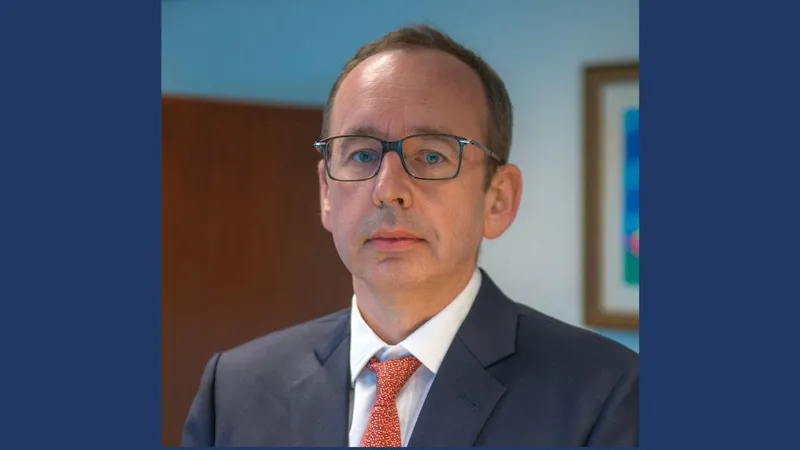
Eugene Zhukov: There is a crisis of war in Ukraine, ADB and Georgian government’s economic team are looking very carefully at the situation and we see there are some possible downside risks to the economy this year
The priority directions of the Asian Development Bank (ADB) in Georgia, the country's water resources potential, even redistribution of economic growth and the dangers that emerged as a result of Russia's invasion of Ukraine - InterPressNews discussed these and other issues with ADB Central and West Asia Director Eugene Zhukov.
Mr Zhukov, you were appointed ADB Director General for Central and West Asia about 1 year ago, could you recap the past year in terms of ADB-Georgia cooperation?
I was appointed to this job in January last year, but this is my second trip to Georgia for the Asian Development Bank. First time I arrived in May 2019 was to negotiate the hosting of ADB’s Annual Meeting, which was supposed to take place in Tbilisi in May 2021. Unfortunately, because of COVID the Annual Meeting calendar was moved, many of them became virtual, but now we have a new plan – we still plan to have a proper Annual Meeting of the Asian Development Bank in Tbilisi, in May 2024, so we look forward to this, because we know Georgian hospitality and we are sure that the government and the people will organize the first-class event for all our guests here.
In terms of ADB in 2022, our priorities remain the same – we support development priorities of the government of Georgia and the country of Georgia. Historically our focus was on infrastructure development. Since Georgia joined ADB about 15 years ago, bulk of our financing went to infrastructure, however, we recently also started to branch out to other areas including health and education and water supply and Livable Cities Development Program. Of course, because of the COVID situation in 2020-2021 we did make some adjustments to our program.
In 2020 we provided 300 million USD in what we call CPRO, basically budget support to give the government some funds to support small businesses and vulnerable populations, and also to provide some funding to procure medical equipment. Last year we approved 15 million USD to a project, which is yet to be disbursed for procurement of COVID vaccines.
Overall, I’m very pleased to say that we had good discussions this week with the government and despite the COVID situation in 2020-2021, our project performance in Georgia remains on track. And our project disbursement projections have been all met for the last two years.
ADB has committed around 4 billion USD throughout these 15 years in Georgia. You have mentioned that ADB’s main priority in Georgia has been the infrastructure. Could you expand on the major infrastructure, transport projects that ADB is running in Georgia right now?
We have an ongoing portfolio of about 1.9 billion USD covering 15 projects and in terms of the dollar value, transport and infrastructure has the main share of it. There are two important transport corridors that we are helping the government to develop. First one is North-South and the second one, I had the opportunity to visit the other day, is the East-West highway connecting the Eastern part of the Georgia to the Western part. We think this corridor, East-West is particularly important now, because Georgia wants to position itself as a logistics transport hub for the region and also for Central Asia.
In addition to that of course we recently approved what we call the Livable Cities investment program, which would cover secondary cities, cities outside Tbilisi and help even regional development. Another project we have in pipeline for this year is Smart Irrigation project. We see a lot of potential for improving productivity of Agriculture in Georgia but what is missing sometimes, is irrigation. We hope this project, which will use best international practices, will facilitate improvement in Agriculture and employment in coming years.
We know that economic growth comes with an increase in electricity consumption. In view of this, Georgia has been stepping up its efforts to better use its water resources for generating electricity. However, we also see that this policy may face obstacles that often relate to local grievances about construction of HPPs. What does Georgia need to do to better manage this process and what can be the role of international actors such as ADB?
Overall, we think that Georgia has quite substantial untapped water resources, I think about 20-30% of the potential has been captured so far, so this is one way to go. Especially in view of ongoing climate change discussion and green growth, I think this is important if Georgia taps this potential.
But in terms of what can be done, I think what ADB and other IFIs can do is to help apply best practices, especially in social and environmental safeguards and what’s important in this situation is to have upfront, advanced, and honest comprehensive consultations with affected population and also to have a very careful look at social and environmental safeguards.
Of course, sometimes the temptation is to go for large HPPs and usually these are projects that can have an impact on local populations, but there is scope for developing sort of run of a river HPPs and with this, concerns for social and environmental safeguards are less.
Last year, according to official statistics, the unemployment rate reached 19% in Georgia. We know that in 2021 ADB approved around 70 Million USD loan to assist Georgia in terms of increasing labor productivity. Can you say that the major factor contributing to the unemployment rate can be labor skills?
When we developed this 70 million USD Modern Skills for Better Jobs program in 2020, we conducted the analysis of the situation and one of the findings was that vocational training and education in Georgia needs to be substantially improved, because we found that there is a mismatch between skills that current education system produces and what employers need.
So the big idea behind this project is to modernize current regional learning centers, improve the curriculum to make it more useful for potential employers. That’s one thing, but another thing is that we are also increasingly working with private sector and local banks to provide finances, credit for the micro, small and medium size enterprises including women-owned and women-managed businesses, so this should also help to improve the employment situation. Again, another project which I mentioned earlier is Smart Irrigation, so we hope this will also provide more jobs in the agriculture sector going forward.
You have already mentioned Agriculture, education, SMEs, are there any other private sector directions, in which ADB engages in Georgia?
When we started operating here in 2007, we were sort of known as a public sector bank, providing large infrastructure financing for the government and government agencies. But increasingly if you noticed, even if you look at the staff, quite a large number of them are what we call private sector arm. Our private sector portfolio in Georgia has been increasing quite a lot. Right now it’s about 445 million USD worth projects for the private sector. Some of the things I have already mentioned. During the COVID period, we have provided small credit lines to Credo Bank and Bank of Georgia to provide support to MSMEs which found themselves in trouble during COVID. We also just got approval for 100 million USD project also for Bank of Georgia again to support MSMEs. Last year we also facilitated private sector investment in railways, with supporting the green bonds issued by the Georgian Railways.
Another scheme which we are working on, not only in Georgia but other countries in Asia-Pacific is trade finance. One of the interesting projects we did last year is affordable housing for 10 million USD for local developers. In that project, what was key was the combination of financing public and private sectors, which was an interesting combination and we hope for more similar collaboration between the public and private sector. In general, private sector projects will become more of a priority going forward.
At the end of 2021, you said that despite significant economic gains over the past years, the growth in Georgia has been unevenly distributed. Last year's statistics too show that the capital Tbilisi is holding 50% of the country’s GDP. What can Georgia do to tackle this issue and how the ADB is assisting in this?
We think that inclusive and balanced development is very important for borrowing member countries. Yes, Tbilisi accounts for 30% of population and 50% of GDPs. Some of our projects we try to grow out, again, these are projects that I mentioned earlier on, like East-West corridor, North-South corridor.
They should facilitate farmers’ access to markets and generate income. Livable Cities Investment Program covers cities outside Tbilisi, again trying to push development in other secondary towns. Our work with the private sector will provide finance and credit to local commercial banks, micro, small and medium sized enterprises, that’s another way that we try to improve development outside Tbilisi. And the last project I also mentioned is Smart Irrigation, this is to facilitate more productive and profitable agriculture production, which is obviously outside Tbilisi.
Georgia’s GDP grew by 10.6% in 2021, while the Foreign Trade posted a 25.6% increase. ADB also projects Georgia’s GDP to go up by 6.5% in 2022. Could we say that the country’s economy is recovering at a sufficient pace from pandemics?
Yes, you are right. The economy contracted by 6% in 2020 and recovered quickly last year, despite COVID still being there at the rate of 10%. I think this is pretty good. Earlier this year we were quite optimistic about growth prospects but we are just about to finish with one crisis and now there is another crisis of war in Ukraine and we and our economic team and government’s economic team are looking very carefully at the situation and we see there are some possible downside risks to the economy this year. This depends on how severe and how long this conflict will last.
What kind of risks are we talking about in particular for Georgia?
I have to say probably the whole world would be affected in general, but I work in the department which covers 10 countries – three countries in Caucasus and 7 countries in Central Asia, former soviet republics, also Pakistan and Afghanistan and most of them will be affected in certain ways.
In case of Georgia there are several transmission mechanisms. First we look at the trade, both Russian Federation and Ukraine are substantial trading partners for Georgian exports and imports. This is one of the areas for downward adjustment.
Second is remittances. Remittances from Russian Federation still represent a substantial amount, and this is another area that will be negatively affected. We also need to mention exchange rates and inflation as those also impose downward risks for the Georgia economy.
ADB stands ready to provide additional assistance to Georgia if the downside risks are realized.
You mentioned remittances and exchange rate, can we say that international sanctions can have a spill-over effect and other areas as well?
There are some Russian Banks which operate here and some of them are sanctioned, that’s another effect. Also, Georgian citizens could transfer money from Russia Federation to Georgia through money transfer and some of these banks as well, maybe they’ll face some difficulties and additional costs in transferring the funds to Georgia.
InterPressNews