Georgian scientists and EU Twinning experts discussed the Green Deal perspectives
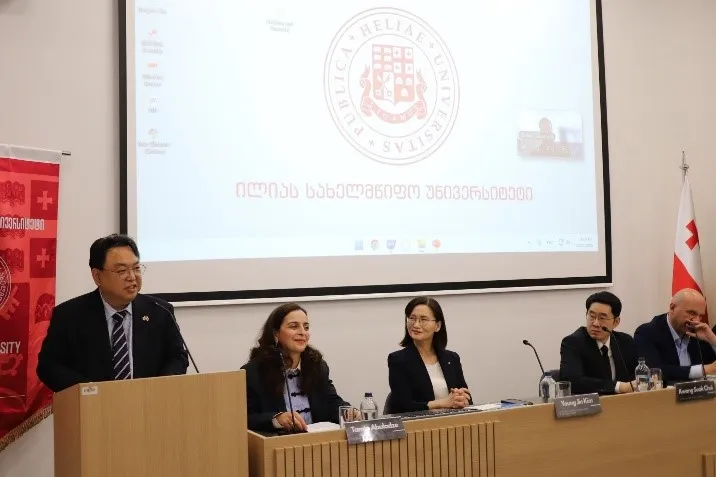
Shota Rustaveli National Science Foundation of Georgia with the support of EU Twinning project on bridging the gap between science and business has organized a seminar on the “Green Deal perspectives and sustainable development”. The event took place within the activities of the ‘European Researchers' Night 2021 implemented by the Ministry of Education and Science of Georgia.
"Nowadays climate change and environmental degradation pose a great threat to the world. The European Green Deal seeks to improve well-being and health of citizens and future generations through clean air and water, healthy food, healthy soil and biodiversity. Indeed, this seminar, is extremely important for Georgian scientists who have been working in this direction for many years, to share knowledge and best practices” – stated Maka Kajaia from Shota Rustaveli National Science Foundation of Georgia.
Experts from Austria and Bulgaria opened discussion with introduction of a European Green Deal and its relation to science. The European Green Deal is aimed to boost the economy through, efficient use of resources, circular economy, stopping climate change, reversing biodiversity loss and cutting pollution.
“Georgia deserves strategies that trigger its great potential for competitiveness. To deliver the transition to a carbon-neutral economy, researchers have to rethink the funding issues, global cooperation and the way of communication with policymakers, scientitsts, business sector and industry, media and culture, and general public. In this case, science communication is essential for linking these sectors of any society and facilitating their active partnership in aspirations towards the green transition and innovation development.” – said Inese Gavarane, the Resident Twinning Advisor, living in Georgia.
The transition towards Circular Economy is already in progress in Georgia. The process towards new technology research and innovation has started with adoption and enactment of the Waste Management Code of Georgia that introduced the concept of Extended Producer Responsibility (EPR) for specific waste streams. This process needs acceleration and support with innovative technologies, developing products with high circularity.
“Is Georgia affected by climate change – and how? Does Georgia have means to counteract global climate change? Yes – on the basis of its new mindset, Georgia may rebuild its energy system and thus embark on "energy transition", just as the most countries in the world, based on its great potentials for renewable energies – and based on good practice examples from other countries, including solar and wind energy. In its essence, the energy system is the manifestation of values of the societal system of a country” – noted Gilbert Ahamer from Environment Agency, Austria.
Optimizing the circular use of resources throughout the economy is a key vector for minimising environmental impacts of the Georgian economy. Construction and demolition waste management is particularly important since they comprise the largest waste stream of the country. This waste has a great potential for recycling in the building sector with the possibility of using other types of recycled waste, for example, textile waste, tyres, industrial waste, etc. for construction purposes. Other key waste streams in circular economy are waste electrical and electronic equipment, used tyres, plastics, textiles etc.
“The challenge is to meet real industry needs, find social solutions, establish partnerships with donors and create business models that “leave no one behind”. In priority areas where new solution and investments are needed in Georgia, the Green Deal policies could ensure just and inclusive transition with great potential for competitiveness” – mentioned Johannes Mayer from Environment Agency, Austria.
(Ad)