Carl Hartzell: I believe the 19 April Agreement has closed at least this chapter of the crisis - it is the beginning of a new era
The parliament, which for several months was first boycotted by the entire opposition and then most of it, was eventually almost completely filled. This result is largely due to the EU-mediated agreement, with the special contribution of the President of the European Council, Charles Michel, his Special Representative, Christian Danielsson, and the EU Embassy in Georgia.
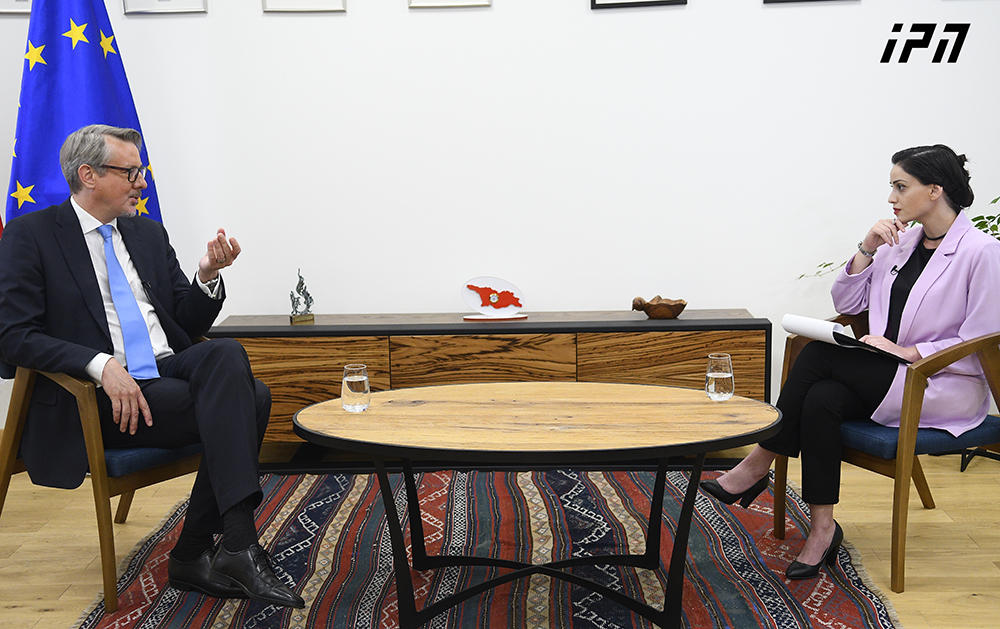
EU Ambassador to Georgia Carl Hartzell speaks exclusively to Interpressnews about the political process following the negotiations and the signing of an agreement between the government and the opposition.
- Following intense negotiations lasting several months, Charles Michel’s document A way ahead of Georgia was signed on 19 April. The contribution of our partners into the result achieved was immeasurable. You said earlier that the Agreement is a new way forward for Georgia. In your view, has the decision to sign the agreement brought an end to the political crisis in Georgia and what needs to be done to continue with what has been achieved through the opposition MPs taking their parliamentary seats?
- I truly believe that the 19 April agreement has closed at least one chapter of the crisis in Georgia - it is the beginning of a new era. So, after almost 6 months of intense talks - first through the facilitation and then through the mediation - everyone knew what the important issues were; for tackling both bringing the different political sides together and setting an important agenda for developing democracy in Georgia. I think, when it comes to the electoral and judicial reforms in particular, and, I would also say, to the power-sharing arrangements and more interaction with the European Parliament etc, all of these are assets, a work plan, if you like, to take the country forward.
It is very important that we now have 148 out of 150 MPs working in Parliament, ready to tackle these challenges, but also to start working and seizing the opportunities that the Parliamentary work brings. However, at the end of the day, it is not over. It is the beginning of a new era. I am sure there will be ups and downs on this path and a lot will depend on the dynamics between different parties and different MP’s, whether they can make sure they can find a conducive working environment that will actually lead to maximum results.
- Do you hope that this new chapter can be free of this kind of deep crisis, polarization and stagnation that we have seen?
- I think it would be unrealistic to think that everything will change with regard to polarization, which is stemming back in time here in Georgia, as we know. But I think there is a real opportunity, including with the new parties that have come to this parliament, to see a bit of a new dynamic hopefully taking shape in the new Parliament.
- During that period, some were saying that the process [of negotiations] was so hard that no more efforts were to be expected from the Western partners if not for PEC’s personal dedication to the Agreement. Do you think that Charles Michel’s factor was decisive in achieving a positive result and what the Georgian political spectrum needs to learn from this experience?
- Well, I think it is quite exceptional the level and intensity coming from the President of the European Council in his efforts to move things forward, which is a clear demonstration of the importance that Europe is putting to Georgia - stability and democracy in Georgia - and working through his envoy, Christian Danielsson also quite intensely over many weeks is testimony to that. What I hope will be part of the lesson learned from this exercise, is the virtues of compromise. In the end, actually, coming to the agreement that very clearly is not an agreement that anyone of the parties will say is ideal - but something that made it possible to turn this chapter and turn a new page in the history books on the Georgian democracy - I think that this spirit is what is needed today and tomorrow as well, when working in Parliament.
- According to the decision by UNM, the party joined the parliament but will not sign the EU-mediated document. Some say that UNM is contradicting itself – if no Agreement was needed to join the Parliament, why was the party boycotting the Parliament then? How would you assess this decision and why is it necessary to join the Parliament through signing Charles Michel’s document in particular?
- First of all, I will always have respect for political choices of political leaders. There are many factors to take into account. But as I have said on many occasions, I truly hope and in the end, I also trust, that UNM will sign up to this agreement. I think it is important because it is part of making sure that everyone in Parliament is committed to the same goals. I think we are seeing some good signs and results of that and we will wish to see UNM also sending that signal of firm commitment. That will allow them to also profit fully from this agreement.
- Speaking of opposition, Giorgi Gakharia resigned from PM’s post in February stating he had failed to reach an agreement in his team regarding UNM’s leader Nika Melia. There is a view that in this way the former PM averted a harsh confrontation. Today, Gakharia is joining Georgia’s political life as an opposition party; he has set up a new party, however, part of the society finds it difficult to trust him due to the developments that took place during his time in office. Few months ago Gakharia had a meeting with you too. What do you expect from his party and, more generally, how do you assess his resignation?
- Well, it is still early days. I would just say that, I think, his decision to enter into politics again and form a new party, in a way, is part of a development that we have seen, with more parties coming and giving a broader choice and pluralism, if you like; which can be an important factor in terms of developing the political discourse in this country. I also know that the six parliamentarians, that have joined his party, also signed up to the agreement. I trust that this is another party that - at the core - is pro-European and will endeavour to promote those ideals. But apart from that, I’m not in a position to say too much - only time will tell.
- I would not want to go into the details about Gakharia, but you mentioned a few moments ago that polarization has a history in Georgia. Taking this into consideration, how realistic does his party’s position seem when they say they will fight for Georgia but against no one?
- I think it is a well-pronounced starting point. And I think that should be the objective of many, I would say. And at the same time, as we know, this party and this party’s leader is already the subject of quite harsh, if you like, polarized comments coming, I guess, from all sides. So, it just testifies to the fact that some of these things are easier said than done.
- Part of the society believes that during the recent period, pro-Russian forces have become more active in Georgia. Do they have a chance to take up a significant niche in Georgia’s political life and achieve a significant success in the elections?
- If by ‘pro-Russian’ you mean a party that at the same time is turning its back on the European path, I find that very difficult to imagine here in Georgia. I think the aspirations, as expressed in opinion polls when it comes to moving towards a closer relationship with Europe, are so strong here that I do not really see them changing any time soon. Obviously, the risk for everyone is the threat of disinformation, sowing seeds of doubt about the European path or trying to put a wedge between the European values versus Georgian values, and so on. I mean, these things we are seeing today and, at the same time, I do not see them - so far at least - getting prominence. It also shows the continued importance of a vibrant civil society, vibrant media, fact-checkers and so on, to withstand such attempts.
- The Georgian government representatives say they intend to make a formal application to EU membership in 2024. However, according to MEP Marina Kaljurand, for example, there is a consensus on EU’s enlargement and it is important to lower Georgia’s ambitions and “manage expectations” because you will not “get a yes” in the planned 2024 EU membership application. How realistic is the Georgian government’s ambition? Will the remaining 3 years be enough for Georgia to do everything it takes to make an application, including to meet the obligations undertaken the AA/DCFTA?
- I think it is clear that this is a very ambitious goal, for sure. I hope that it will be used, and should be seen as a signal of, actually, gearing up more ambitiously when it comes to the implementation of the Association Agreement, and the Deep and Comprehensive Free Trade Area, for which there should be a lot of support within Parliament. If that happens, I think it is very welcome, because it is an agenda that we have set together and is in itself also working towards greater cooperation and integration of Georgia into wider European structures. Then, when it comes to the membership application, it is a complex process and a European state can, according to the Treaty, apply for membership, if dedicated to upholding and developing European values, which are human rights, rule of law and all of those, which are also part of the reform package that we have defined in the Association Agreement. So, with the right ambition, the right spin and the right support for these ambitions, I think it is a good way for making sure that Georgia stays on the path we all wish to see Georgia on, namely towards closer cooperation and closer integration with the EU.
- There is a difference in views regarding the amnesty of those involved in the 19-20 June developments. The victims have applied to you with a letter which said that it was ‘unacceptable in principle’ that the amnesty covers those who were in charge. There were assessments according to which such a step would ‘cross of this date from history’ and, due to the gravity of the violations, would prevent the execution of justice. What is your position – how necessary was it to introduce the point on amnesty [into the Agreement] and is there a risk of creating or intensifying impunity in this country?
- I am fully cognizant of the fact that this Amnesty law is a complicated issue and a painful one as well. At the same time, through the negotiations it was clear to us that this - as part of the overall agreement - was a necessity for addressing the issue of the perceptions of politicized justice. What is important now, I believe, is that the work that is ongoing in Parliament, will result in an outcome that is done with full respect for the Georgian law and the principles of the European Convention of Human Rights, etc. I think it is a step towards unlocking the overall agreement, which will bring also further democracy to Georgia and further strengthening of the rule of law, which is an important aspect also, if you’d like, linked to some of the issues that has come in the aftermath of 19-20 June.
- In your comments you said that it is important to pause with regard to the election of the Supreme Court judges and appointment of new members to the Justice Council and that it is very important not to make hasty decisions. What do you think are the risks facing the state in case of haste and what should be the main factors to be taken into account while working on these issues?
- First of all, these judicial reforms were a really important part of the agreement and part of the roadmap that many of the parties have now subscribed to. I believe that the principle set out with regard to taking this work forward is to make sure it becomes an inclusive and transparent process; and on the basis of a cross-party consensus it will move forward. It is very important when undertaking electoral reform, as well as when you do these reforms, that there is a buy-in from different sides. The appointment procedures are part of that. They are also part of the agreement. And it matters - as we know - who will be selected, on what basis, through what procedures etc. To me it is absolutely clear that not rushing these appointments is a necessity in order to instill maximum trust at an early stage of this process that will go on for many months. Therefore, I plead not to haste, but to make sure that it’s being taken forward in this inclusive cross-party way.
- It has been a few months that part of the population opposes the Namakhvani HPP construction. They have certain demands and ask for the suspension of works as well as the resignation of the Minister of the Economy who had signed the agreement with the Turkish company. As the Minister of the Economy said, the state is ready to start communicating with the activists from a ‘blank page’, including through the EU mediation. What is your position on this and what positive contribution you expect to make in the process?
- These projects are always sensitive. As the EU, we don’t have a direct stake in this HPP, thus we do not have the full picture. But our starting point has been to say that it is necessary, against the background of what we have seen playing out in the recent weeks, to find a good platform for a dialogue. And this is what we have been pleading for, in order to make sure that projects such as this gains maximum trust and, in the end, is the right choice. For Georgia, it is important that there is a thorough environmental and social impact study done, and, I think, we might need to go back and look at that. The engagement of the European Energy Charter Secretariat, who has offered to come and mediate or facilitate talks between the sides, is a good step because, I think, they are the right body able to carry this out - both due to the technical expertise and due to being seen as an independent party, unbiased in these discussions. As far as I can tell, this is how the different sides are seeing the role of the Secretariat.
- Would you say a few words about the recent EU projects and where [in which sector] is their main focus today? For example, better HR protection, fighting Covid -to which you have provided enourmous contribution; also, enormous attention is paid to education – which projects are you proud of most and are there new initiatives you intent to launch in the near future?
- That is a very difficult question, because we are engaged in so many sectors here. I think every year we are entering into something new, rather than jumping between different priorities. I think, right now we have something like 200 projects ongoing in Georgia. Perhaps starting out with our Covid -19 response, you will have heard me say before that I am actually proud of the fact that we managed last year to move very quickly into this crisis mode - able to support the government with its anti-crisis plan, supported also both with advice and with financing. And, at the same time, trying to reach out and help small and medium-sized enterprises, help vulnerable groups, working very closely with the World Health Organization, to roll out many of the supplies and medical needs that were evident in the health sector, etc. That has taken a lot of work and I am very proud of my staff who have been working under these difficult conditions of Covid-19 and teleworking, and still, at the same time, managing to actually come out the way we have.
For the rest, it is difficult for me to pinpoint just a few things. But I recently made a trip to Adjara, where we went to Keda, and there we saw the results of something I truly believe in - and I’m happy to always support and promote - and this is our local action groups (LAGs). We have a very lively LAG in Keda that has done a lot of projects where the municipality, the actors - the people in Keda -themselves set their priorities, both with regard to tourism, social issues, environmental issues etc. This is a model I believe in and it links to something that we will try to do more in the coming years - to work more with regions, so getting away from Tbilisi, Batumi, Kutaisi focused approaches and try to make sure that there is more empowerment in the regions to take decisions and set their own priorities and so on. There we are going to be rolling out more project initiatives in the coming year.
Then, education which is super important. We are supporting education at different levels. In the last year we have had a special focus on vocational training, which, I think, is an important contribution, because, hopefully, it should be the response to the fact that there is unemployment in this country; and on the other hand, when it comes to certain professions, there is demand that has not been met. So, by doing the right matching between the market demand and making sure that we can support proper training for these type of professions, we hope to get more people into meaningful work and also help all the companies - the majority of which are small and medium-sized enterprises - to really get moving on their ambitions..
Then, environment is always an important issue for me. I see it coming especially with the younger generation, but it is also coming through the fact that, as Georgia is developing its tourism industry, more and more municipalities and also enterprises are seeing the necessity to do more to preserve the wonderful nature here in Georgia. I think this is exactly the right priority and I hope this demand will just continue to grow in the coming years.
So, these were just a few observations on things we are up to.
- You have been in Georgia for quite some time already. In addition to diplomacy and active engagement in the political developments, how is your life in this country? What is your biggest impression while in Georgia?
- To be frank, over the past couple of months, a lot of my time has gone into what you said - politics and diplomacy. At the same time, some of the best moments I’ve had during my almost 3 years here were those when going out and meeting people and seeing different parts of Georgia, which has a treasure of beautiful landscapes, cultural heritage, fascinating history, combined with excellent wines and food. But the most important thing, and it is something I say very sincerely, is the generosity, the friendship, hospitality of the Georgian people that is absolutely stunning and humbling - it is something without which all the rest would have become less of an attraction, I would say. The combination of all of these things is truly making this country, Georgia, a very special and enjoyable place to be in.
Eka Abashidze
InterPressNews